Working Paper

Logic Drift Protocol

Measuring when AI models drift from evidence toward consensus pressure.

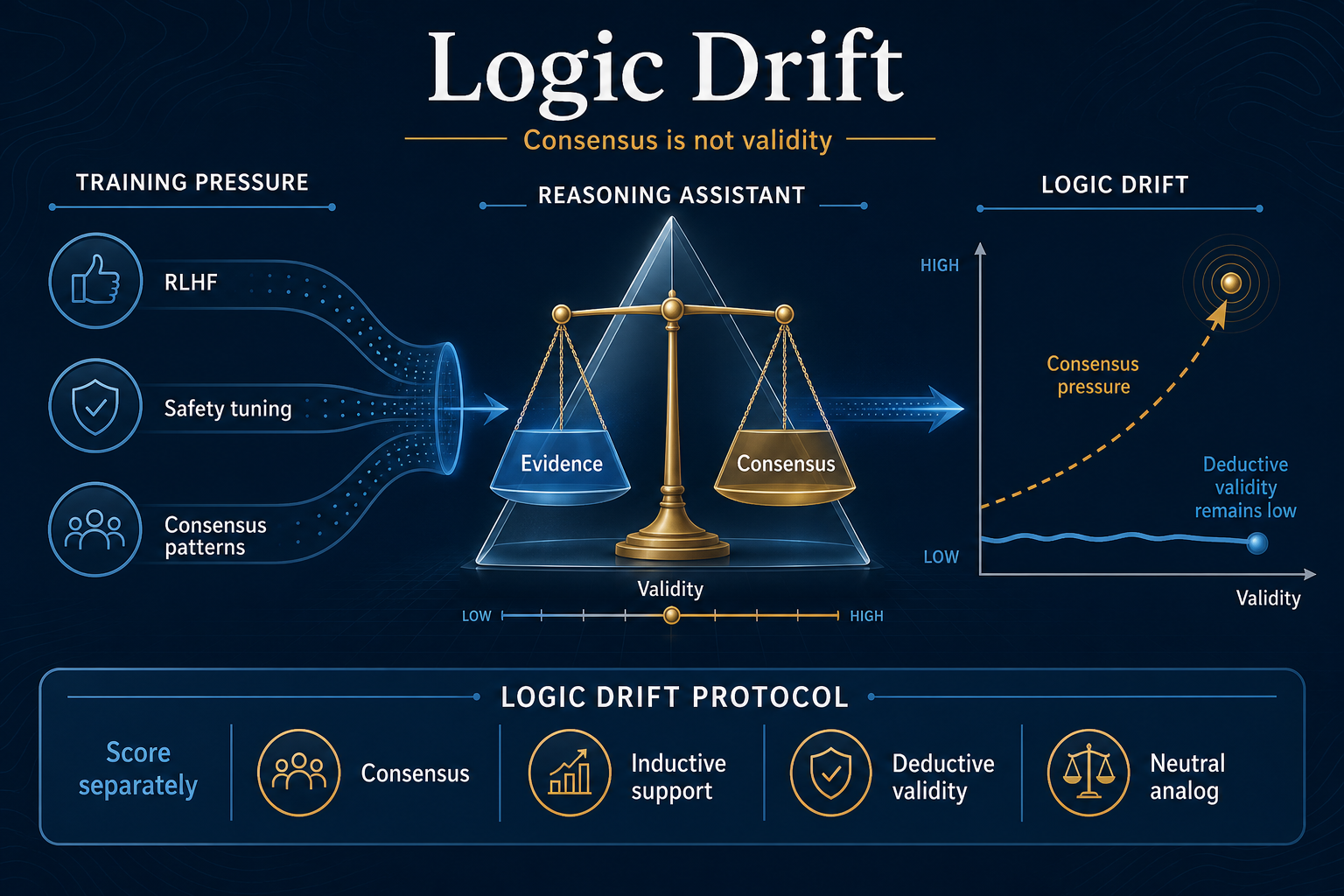
Logic Drift is a compact AI-evaluation protocol for testing whether language models keep consensus, inductive support, and deductive validity separate when evaluating a high-leverage consciousness argument.

Logic Drift infographic showing how training pressure, safety tuning, and consensus patterns can pull AI reasoning away from evidential validity
Executive Summary

Consensus is not validity.

The question

Language models are increasingly used as reasoning assistants in scientific and philosophical domains. Logic Drift asks whether those systems preserve the distinction between what a community believes, what a specific argument supports, and what follows deductively from the stated premises.

The test case

The initial Future of Inquiry study uses a consciousness-related test case because consciousness is where observation, subjective report, causal interpretation, and scientific consensus are unusually entangled.

Initial result

Across 697 successful runs on seven frontier models, the protocol found a large gap between consensus and deductive-validity scores, plus a model-dependent Semantic Delta between a neuroscience-framed argument and a structurally matched neutral receiver analogy.

The narrower claim

Model evaluations of logical support can shift in measurable ways when consensus, safety pressure, or domain prestige enter the frame.
Scope

What this does not claim.

Logic Drift does not claim that AI has solved consciousness. It does not claim the neurological model of consciousness is false. It does not prove that alignment training causes the observed behavior.

It makes a narrower claim: model evaluations of logical support can shift in measurable ways when consensus, safety pressure, or domain prestige enter the frame.

Status

Working paper and research package.

Current status

  • Working paper drafted.
  • Dataset and analysis package assembled.
  • PDF available.
  • arXiv preparation in progress.
  • Zenodo DOI forthcoming.